
General News & Updates – August 2026
Reminder: Cognitive Control System Theme Day #
Participating researchers are kindly requested to prepare their scientific contributions and paradigm spotlights according to the event schedule.
Participating researchers are kindly requested to prepare their scientific contributions and paradigm spotlights according to the event schedule.

Diversity, equity, and inclusion (DEI) are values essential to fostering an accessible and fair workplace for all. Discussing these values encourages individuals to develop empathy and critical thinking.
In this form, you can ask anything you want about DEI issues, and we will answer in the next newsletter, aiming to foster valuable future discussions.

The next TRR 379 Consortium Retreat will take place at the Seminaris Hotel Bad Honnef. The registration list is active on GitLab. Please register by the deadline at the end of August. Registrations are binding; the final deadline for room cancellations without penalty is February 1st. Late cancellations require attendees to cover accommodation and seminar costs individually.

Please find here a short video explaining our subproject “B04: Investigating psychological and neural correlates of intimate partner violence”.
This project investigates psychological and neural correlates of cognitive control deficits during conflict situations, focusing on self-regulation and co-regulation dynamics using fMRI, hyperscanning, skin conductance, and EMA.

At the 2nd TRR 379 Retreat on February 12-13, 2026, our team came together to discuss the collaborative research driving our understanding of aggression. Our social media team captured the essence of this gathering in a video that explores why TRR 379 matters - highlighting the social and scientific importance of aggression research and the unique value of collaborative research consortia like ours.

The new unified TRR presentation template is now available in GitLab within the Common Resources/Templates folder. This template is specifically designed for all upcoming internal presentations for the General Assembly and the Retreats to ensure a consistent visual identity across the entire TRR 379 project.

We would love to take you on a journey through our project. Please find here a video explaining a bit about the subproject “B02: Young offenders’ self-regulation deficit as a common mechanism for aggressive behavior and psychopathology - neural mechanisms and role of adverse childhood experiences”
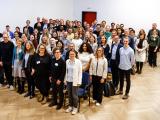
The 2nd TRR 379 Retreat brought together nearly 100 team members on February 12-13, 2026, for two days of productive scientific exchange and collaboration. Following the successful first retreat in 2025, this year’s event strengthened connections across all project areas and generated excitement for the work ahead.
The 2nd TRR 379 Retreat will take place on Thursday, 12th, and Friday, 13th February 2026, bringing together all members of the TRR 379 community for two days of scientific exchange, discussion, and networking. The retreat provides a comprehensive program designed to showcase the latest research progress, foster collaboration across project areas, and reflect on the past year of the TRR.
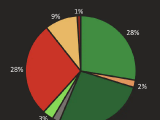
Following the conclusion of the 2025 reporting year, we have analyzed the data from our coordinated programs. Transparency is a key component of our research culture, which is why we are sharing a detailed look at the people behind TRR 379.

We would love to take you on a journey through our project. Please find here a video explaining a bit about the subproject “A08: The metabolic lung-brain axis in aggressive behavior in patients with AMD”

The Distribits 2025 conference and hackathon (23-25 October in Düsseldorf, Germany) will bring together researchers, software developers, and other data enthusiasts working on distributed data management technologies and FAIR workflows. These themes are integral to the decentralized data management infrastructure employed within the TRR 379. Namely, this year’s Distribits event will feature talks on the development and application of DataLad, git-annex, and other distributed data tools, which are core technologies enabling version control, sharing, and reproducibility of datasets across TRR 379 sites.

On September 3, 2025, the TRR 379 successfully rolled out the DFG’s (Deutsche Forschungsgemeinschaft) annual survey on coordinated programmes using the TRR 379’s integrated metadata system, reflecting the consortium’s commitment to data-driven research management.

We would love to take you on a journey through our project. Please find here a video explaining a bit about the subproject “A06: Decoding dynamic reciprocal neural mechanism underlying reactive aggression: Insights from fMRI and fNIRS hyperscanning”


We would love to take you on a journey through our project. Please find here a video explaining a bit about the subproject “A05: Peripersonal space violations and social threat: daily-life psychological and neural mechanisms of environmental risk for reactive aggression”

We would love to take you on a journey through our project! Here we present a special media project created for children and overwhelmed relatives, explaining our research through the adventures of Amygdala-Alarmina and Sniffy the Nose.

Ute Habel is co-author of a new publication on the neuroanatomical correlates of psychopathy, which was recently published in the European Archives of Psychiatry and Clinical Neurosciences.
The study examined structural MRI data from 39 male patients with psychopathy and identified a variety of volume reductions. This study is the result of close collaboration between Forschungszentrum Jülich, RWTH Aachen University (together in the JARA-BRAIUN cooperation), Heinrich Heine University Düsseldorf, Georg August University Göttingen, and the University of Pennsylvania, using the Julich Brain Atlas and EBRAINS.

Effectively preventing violence means not only controlling it, but also understanding it: The German Society for Psychiatry and Psychotherapy, Psychosomatics and Neurology (DGPPN) has now published a fundamental statement on violence prevention, in which therapeutic approaches are highlighted as a key measure. ‘The best way to prevent violence is through targeted and scientifically based therapy,’ is the tenor of the DGPPN statement. This is based on the latest findings in psychiatry, psychotherapy and neuroscience.

In a large and multidisciplinary research network, active efforts to promote equal treatment and equality are of great importance. The Equal Opportunity Committee has been working on this issue with great commitment since the start of the project and, following the EOC manifesto signed by all members, has now published two concrete guidelines for TRR members. The two flyers, ‘How to access family support services at your institution’ and ‘What to do if you experience discrimination,’ are now available in the internal area of the SFB.
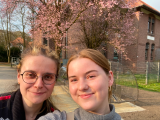
Dr. Christiane Licht(Left), a postdoctoral researcher and Christina Neczewicz (right), a doctoral student of medicine at RWTH Aachen, visited the LVR-Klinik in Viersen,Germany today. Building on the initial visit that kickstarted the research on the Q01 research project, we focused on continuing and complementing patient surveys, recruiting additional patients, and collecting biosamples for further analysis.
We would love to take you on a journey through our project. Please find here a video explaining a bit about the subproject “A03: Using State-of-the-Art Neuroimaging Techniques to Explore Aggression and Acute Threat Processing”
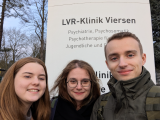
Today, Christina Neczewicz (left) and Joris Burger (right), doctoral research students at RWTH Aachen University, and Dr. Christiane Licht (center) had an appointment at the LVR-Klinik Viersen, recruiting additional forensic patients. We are looking forward to this coming collaboration regarding recruitment in Q01.
We would love to take you on a journey through our project. Please find here a video explaining a bit about the subproject “A02: Context effects on threat processing in dependence of testosterone levels”

Certainly, we took the opportunity to have a group picture taken from our team. We were close to 100 people, with only a few missing.
